Get the Dirt on Section 180: Could Your Soil Hold a Tax Deduction?

When you buy farmland, you’re investing in what’s below the surface, too. Fertilizer applied by the previous owner may still be in the ground, ready to support future crops.
That remaining fertilizer supply, often called residual fertility, may represent a tax deduction opportunity. At Red Cedar Ag, we help you start with the soil data and connect the findings to a conversation with your CPA through EarthOptics and its partner.
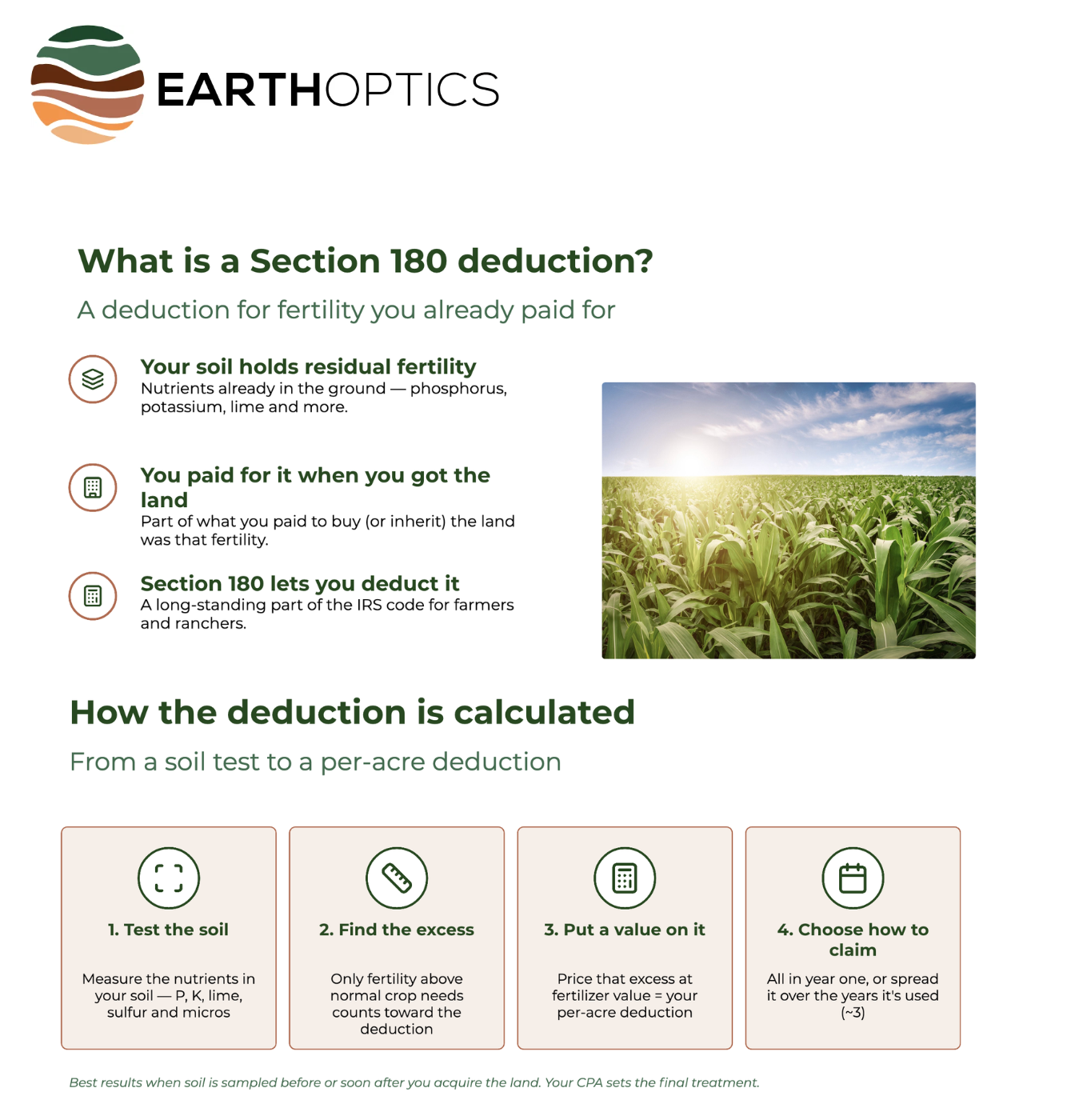
What is a Section 180 deduction?
Section 180 allows taxpayers engaged in the business of farming to elect to deduct qualifying fertilizer, lime, and soil amendment expenses in the year paid or incurred, even when the benefits last longer than one year. IRS Farmer’s Tax Guide.
For purchased farmland, a potential residual fertility deduction involves identifying a supportable portion of the purchase price attributable to unused fertilizer applied before the purchase. High nutrient levels alone don’t establish eligibility. Documentation must support the fertilizer’s presence, its connection to prior applications, and its use over time. Guidance on this treatment is limited, making your CPA’s review essential. USDA-hosted residual fertility guidance.
Which land should you bring in for review?
Recently purchased cropland is a practical place to start. Pasture and rangeland can also be evaluated, but land use alone doesn’t establish eligibility: evidence of remaining fertilizer from past applications matters.
Your role in the operation matters, too. Section 180 requires being engaged in the business of farming. Simply owning land and collecting cash rent generally doesn’t meet that requirement without material participation. USDA-hosted residual fertility guidance.
If you inherited land, or own it through a trust or LLC, bring that information into the conversation early. Those situations require a separate review of ownership, tax basis, and who could claim any available deduction.
What could the deduction be worth?
The examples shared in our presentation include potential deductions of $1,000 or more per acre, with one local grower’s reported figure around $2,600 per acre. Those figures are individual examples, not a standard rate or a promise of what your farm will qualify for.
The amount supported for your property depends on its history, documentation, and tax circumstances. Your CPA must review the report before any amount is claimed.
A deduction reduces taxable income; it is not a dollar-for-dollar tax refund. For illustration, an allowable $1,000 deduction at a 25% marginal income tax rate would reduce income tax by approximately $250, before other tax effects.
How does the process work?
Red Cedar Ag helps you gather the information needed to get started.
- Review your soil data. Existing grid samples at 2.5-, 5-, or 10-acre spacing may be usable, depending on their timing, quality, and coverage. If the available records aren’t sufficient, we can discuss sampling the fields. Testing before or soon after acquisition helps document starting conditions.
- Process the information. The data goes through EarthOptics and its partner for evaluation and preparation of the supporting report.
- Receive your documentation package. You receive a report to take to your CPA or tax advisor, along with relevant acquisition and fertilizer history records.
The report supports your tax review; it does not guarantee a deduction.
What happens after you receive the report?
Your CPA reviews eligibility, the supported amount, and the appropriate tax treatment. For qualifying fertilizer expenses, the rules may allow an immediate deduction or recovery over the period of benefit. The timing must follow applicable tax rules; there is no standard three-year schedule or unrestricted choice of tax year. IRS Farmer’s Tax Guide.
The program also includes audit support for the supporting work at no additional cost, as outlined in our presentation. Ask us about the scope of that support when getting started.
How do future plans affect the decision?
Tell your CPA whether you plan to keep the ground, sell it, exchange it, or pass it to the next generation.
If you sell, the IRS explains that proceeds attributable to fertilizer or lime may need to be reported as ordinary income. Your advisor should evaluate how earlier deductions and the sale allocation affect your return. IRS Farmer’s Tax Guide.
A 1031 exchange requires additional review. Replacement property generally carries forward tax basis from the exchanged property, with applicable adjustments. Having enough basis alone does not establish eligibility for a residual fertility deduction. IRS guidance on like-kind exchanges.
Inherited property generally receives a basis tied to its fair market value at death, subject to exceptions. That adjustment does not automatically establish a new Section 180 deduction. Have your CPA and estate attorney review inherited land, trusts, and any implications of prior deductions together. IRS guidance on inherited property.
Ready to get started?
Contact Red Cedar Ag. We’ll help gather a few key details:
- Property location and acreage
- Current land use
- Month, year, and method of acquisition
- Purchase price or available tax basis information
- Existing soil data and sampling dates
- Available fertilizer application history
From there, we can help determine the next steps for your soil data and documentation. With Red Cedar Ag, EarthOptics, and your tax advisor involved, you’ll have a clearer picture of the opportunity and the information needed to evaluate it.
This article is for general education. Your CPA or tax advisor determines eligibility and the appropriate treatment for your circumstances.